Regulation (EU) 2026/1740: the default values, replaced
The August correction replaced Annexes I and IV retroactively to 1 January — new numbers, a new data model, TARIC-level codes, and a route column that finally works. Read against the act itself.
Last updated 23 September 2026
On 20 July 2026 the European Commission adopted Implementing Regulation (EU) 2026/1740. It was published in the Official Journal on 31 July, entered into force on the third day after publication, and applies from 1 January 2026.
It is a short act — two articles — and it does one thing. It replaces Annexes I and IV of Implementing Regulation (EU) 2025/2621 in their entirety.
Not amends. Replaces. Article 1 reads: “Annex I to Implementing Regulation (EU) 2025/2621 is replaced by the text in Annex I to this Regulation”, and the same for Annex IV.
Annex I is titled “Default values for goods imported into the customs territory of the Union, except for electricity”; Annex IV carries “Default values for precursors for which the country of production cannot be identified”. For the non-electricity goods covered by this article, those two annexes provide the default-value inputs used in determining the embedded emissions that feed into the CBAM certificate calculation.
One naming point, because it will otherwise trip you up: unless I say otherwise, “Annex I” and “Annex IV” in this article mean the annexes to Implementing Regulation (EU) 2025/2621. The CBAM Regulation itself also has an Annex IV, and it is a different thing — the methods for calculating embedded emissions. Where I mean that one, I name the act.
I have read the act in full — all fifteen recitals and both replacement annexes. Most commentary on it will stop at “some default values were corrected.” That is true and it is the least interesting part. The substantive change is that the annex is no longer the same kind of object it was in December, and a handful of the corrections are only visible if you were already trying to implement the old text.
I was. So let me go through it properly.
The short version
Regulation (EU) 2026/1740 does not simply correct a handful of CBAM default values. It replaces Annexes I and IV of Implementing Regulation (EU) 2025/2621, changes the structure of the published default-value data, introduces additional tariff-level distinctions for certain goods, and changes how the 2026 default-value calculation must be implemented.
For software, the important change is not just new numbers. It is a new data model.
1. Where default values sit in the legal architecture
Five instruments matter here, and the names are worth getting right because people mix them up constantly.
Regulation (EU) 2023/956 of the European Parliament and of the Council (OJ L 130, 16.5.2023, p. 52) is the CBAM Regulation itself. Article 7 governs the calculation of embedded emissions, with Article 7(2) setting the actual-value/default-value routes for goods other than electricity and Article 7(7) providing the empowerment for implementing acts on the calculation methods and default values. The two default-value acts below are adopted under Article 7(7).
Regulation (EU) 2025/2083 of the European Parliament and of the Council of 8 October 2025 (OJ L, 2025/2083, 17.10.2025) amended 2023/956 “as regards simplifying and strengthening the carbon border adjustment mechanism” — the CBAM simplification amendment. It changed scope, and — as we will see in §6 — that scope change reaches down into the annexes in a way that is easy to miss.
Commission Implementing Regulation (EU) 2023/1773 of 17 August 2023 (OJ L 228, 15.9.2023, p. 94) governed reporting obligations during the transitional period — 1 October 2023 to 31 December 2025 — under Article 35(7) of the CBAM Regulation. It is spent as a reporting instrument, but it is not irrelevant: it is where several of the methodological positions carried into the definitive regime were first written down, and §6 turns on one of them.
Commission Implementing Regulation (EU) 2025/2621 of 16 December 2025 (OJ L, 2025/2621, 31.12.2025) lays down the rules for the establishment of default values. This is the act being corrected.
Commission Implementing Regulation (EU) 2025/2620, also of 16 December 2025 (OJ L, 2025/2620, 22.12.2025), lays down the rules for calculating the free allocation adjustment to the number of CBAM certificates to be surrendered. It defines the CBAM benchmark. It is 2621’s sibling and the two only work together — a fact that turns out to be central to the first correction in the list.
Note the publication dates: 2620 on 22 December, 2621 on 31 December — and 2621 applicable from 1 January. The Commission is candid about what that timetable cost. Recital 7 of the correcting regulation says the tables contained transcription mistakes made “when the tables were consolidated within a short time frame to ensure that Implementing Regulation (EU) 2025/2621 could apply from 1 January 2026.”
That sentence is the whole context for this act. A very large table was assembled against a hard legal deadline, and some of it came out wrong.
2. What the old Annex I looked like
The version adopted in December carried, for each country and each product code, a row with:
- direct emissions default
- indirect emissions default
- total emissions default
- and then three further columns: the default value with the mark-up already applied, one for 2026, one for 2027, one for 2028
Those last three were the operative numbers. You looked up your country and your CN code, read the column for the relevant year, and that was the figure your certificate count was built on. The arithmetic had been done for you.
The mark-up itself is the policy instrument. A default value stands in for an emissions figure nobody has proven, and it is deliberately biased upward so that proving an actual value remains worth doing. The rates are 10 % for 2026, 20 % for 2027 and 30 % for 2028 onwards in the cement, iron and steel, aluminium and hydrogen sectors, and 1 % for fertilisers from 2026 onwards.
Those rates have not changed. What changed is where the multiplication happens.
3. The change that reshapes the object: the pre-computed columns are gone
This is the correction with the widest reach, and it is stated almost in passing, in recital 10:
“Rounding rules have been applied when determining the default values. In order to avoid potential inconsistencies as a result of rounding, the columns with default values that include mark-ups in all the tables for 2026, 2027 and 2028 in Annexes I and IV to Implementing Regulation (EU) 2025/2621 should be deleted.”
The replacement Annex I has six data columns, and these are its published headings:
- Product CN Code / TARIC Code
- Description
- Default Value (direct emissions) — tCO₂eq/tonne of good
- Default Value (indirect emissions) — tCO₂eq/tonne of good
- Default Value (total emissions) — tCO₂eq/tonne of good
- Underlying production route determining CBAM BM
No year columns. They are not empty — they do not exist.
In their place, the introductory part of Annex I now states the method:
“For the calculation of the number of CBAM certificates, the default values of the column ‘total emissions’ shall be selected and increased as follows: For goods in the cement, iron and steel, aluminium and hydrogen sectors, the mark-up shall be 10 % for the year 2026, 20 % for the year 2027 and 30 % for the year 2028 and onwards. For goods in the fertiliser sector, the mark-up shall be 1 % for the year 2026 and onwards.”
Recital 10 continues: the final values including the mark-ups “should then be calculated within the CBAM Registry and this calculation should be based on the default values for total emissions as provided for in Annex I. The default values for direct emissions and indirect emissions in Annex I have only been provided for information.”
Three consequences, and I want to separate them because they are not the same consequence.
First, the annex stopped publishing a result and started publishing an operand. In December you could read the year-specific, marked-up number straight off the page. You now read the total-emissions default value, and the Registry applies the prescribed mark-up to it. That is a different relationship between the legal text and the figure used in the calculation.
Second, the arithmetic basis is now explicit and it is the total. Not direct. Not direct plus a separately marked-up indirect. The total emissions column is the operand to which the applicable sector mark-up is applied. If any part of your process applies the mark-up to a direct-emissions figure alone, that process is not following the calculation specified for the default-value route. The direct and indirect columns remain in Annex I, but the replacement annex states that they are provided for information.
Third — and this is the part I find genuinely interesting — the stated reason is numerical, not legal.
Consider what a pre-multiplied, pre-rounded column actually is. You take a base value that is itself the product of a methodology, multiply it by 1.10, and round the product for publication. A reader who instead takes the published base and multiplies it themselves can get a slightly different number, because their multiplication happens at full precision and the published one did not. Two parties can therefore arrive at different figures while working from the same published table. The disagreement is small per tonne and entirely real at volume.
The Commission’s fix is the one a numerical analyst would recommend: publish the operand, define the operation, and let one implementation perform it. Rounding then happens once, at the end, in the same place for everyone.
That is a well-made decision and it deserves to be recognised as one. It is also the change most likely to break something quietly in systems built against the December text, because nothing about it produces an error — it produces a slightly wrong number.
I will come back to this in §10, because we ran into the same problem from the other side.
4. What this correction does not change: actual values remain a separate route
The correction concerns the default-value route. It does not make default values mandatory in cases where the CBAM Regulation permits embedded emissions to be determined using actual values.
For goods other than electricity, Article 7(2) of Regulation (EU) 2023/956 provides for embedded emissions to be determined either “based on the actual emissions in accordance with the methods set out in points 2 and 3 of Annex IV” or “by reference to default values in accordance with the methods set out in point 4.1 of Annex IV” — Annex IV to the CBAM Regulation, which carries the calculation methods, not the precursor annex to 2025/2621. The correction in Regulation (EU) 2026/1740 concerns the second route: the structure and content of the default-value tables.
Point 4.1 is also where the default values get their shape: they “shall be set at the average emission intensity of each exporting country and for each of the goods listed in Annex I other than electricity, increased by a proportionately designed mark-up.” That is the provision the annex we are discussing implements.
That distinction matters for implementation. A system should not treat the default-value table as the universal source of embedded emissions. It should first establish which calculation route applies, and only then resolve the relevant default value where the default-value route is being used.
A useful implementation model is:
Calculation route → embedded-emissions determination → default-value lookup, where applicable → applicable mark-up → free-allocation adjustment → carbon-price reduction, where applicable → certificates to be surrendered.
The 2026/1740 correction changes the default-value part of that chain. It does not replace the actual-values route. Nor is a default value the same thing as a CBAM benchmark: the default value is used in determining embedded emissions, while the benchmark is a separate input to the free-allocation adjustment under Implementing Regulation (EU) 2025/2620.
5. White clinker, grey clinker, and a column that was blank
Recital 5 is four sentences long and it is the correction I would draw an implementer’s attention to first.
“As regards CN code 2523 10 00 in all the tables in Annexes I and IV to Implementing Regulation (EU) 2025/2621, different default values apply to white clinker and grey clinker. The same applies to the default values for white hydraulic cement and grey hydraulic cements under CN code 2523 90 00 in those Annexes. In order to reflect those differences more clearly, TARIC codes should be used to distinguish between those goods.”
Here is why that matters more than it reads.
White and grey clinker are not merely a labelling distinction. The applicable technical criteria define the distinction, and Implementing Regulation (EU) 2025/2620 defines white cement clinker by composition, in point 5.2.1:
“‘White cement clinker’ means cement clinker for use as main binding component in the formulation of materials such as joint fillers, ceramic tile adhesives, insulation, and anchorage mortars, industrial floor mortars, ready mixed plaster, repair mortars, and water-tight coatings with maximum average contents of 0,4 mass-% Fe₂O₃, 0,003 mass-% Cr₂O₃ and 0,03 mass-% Mn₂O₃.”
Grey cement clinker is then defined by exclusion: “other cement clinker than white cement clinker.”
Those three thresholds are why this is a production question rather than a colour question. Iron oxide is both the principal colourant and a flux in the kiln; holding it below 0,4 % by mass means different raw materials and a different burn. Different process, different emissions intensity — which is why the annex has always carried different default values for the two.
But CN 2523 10 00 covers both. At eight digits there is no code that separates them. So the December annex had two goods with two different default values sharing one row identifier, and the distinction lived in the Description text rather than in the code.
The correcting regulation resolves this by moving to ten-digit TARIC codes. In the replacement annex the cement block now reads, per country:
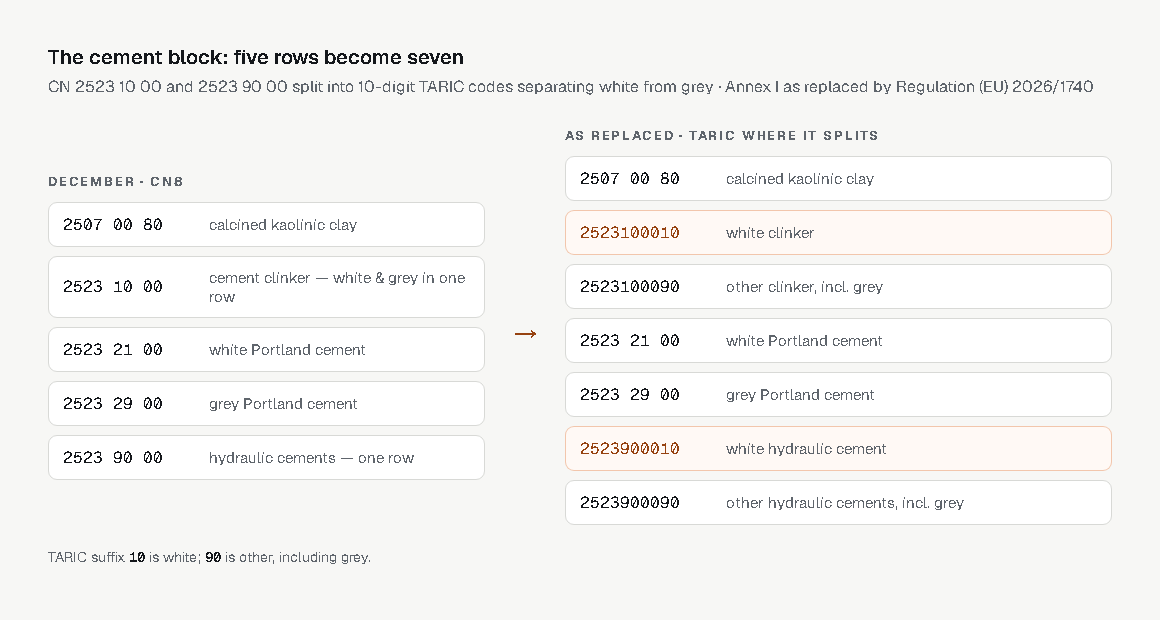
Seven rows where there were five. The TARIC suffix 10 is white; 90 is other, including grey.
To make it concrete, Albania’s cement block in the corrected annex:
- 2523100010, White clinker — no value
- 2523100090, Other clinker including grey clinker — direct 0,870 / indirect 0,000 / total 0,870, production route (A)
- 2523 21 00, White Portland cement — no value
- 2523 29 00, Grey Portland cement — 0,900 / 0,030 / 0,930, no production route
- 2523900010, White hydraulic cement — no value
- 2523900090, Other hydraulic cements including grey hydraulic cements — 0,860 / 0,030 / 0,890, route (A)
The practical consequence is blunt: if your import data stops at eight digits, you can no longer select a default value for clinker or for hydraulic cement. Not “you might pick the wrong one” — you cannot pick. The information required to identify the row is not in a CN8 code.
For anyone whose customs data comes from a national declaration, this is a data-model question, not a lookup question. The relevant TARIC granularity is available in the customs declaration data; whether it survives into the CBAM data model or spreadsheet is another matter.
And there is a sentence in the same point of 2025/2620 that is easy to read past. For other hydraulic cements under CN 2523 90 00 containing a mixture of white clinker and grey clinker and/or calcined clay, the CBAM benchmark “shall be calculated as a weighted average that reflects the composition.” This is a benchmark/free-allocation-adjustment issue, not a statement that the TARIC code itself reveals the composition of the product.
Read that against the TARIC split. The new codes tell you which row to read. They do not tell you what is in the bag. For a blended hydraulic cement you still need the composition, and the benchmark is a function of it.
We ran into this from the inside while implementing the December text, months before the Commission fixed it. I will show that in §10 rather than assert it here.
6. A scope change disguised as a code change
Recital 6 concerns CN code 2507 00 80, which is “kaolin and other kaolinic clays, other”.
Regulation (EU) 2025/2083 amended the CBAM Regulation with the result that only calcined kaolinic clay now falls within scope. Uncalcined material in the same CN code is out.
The annex previously carried the whole eight-digit code. The corrected annex carries TARIC code 2507 00 80 80, described in the table simply as “Calcined clay”.
CN8 identifies the classification at the Combined Nomenclature level; a TARIC10 subdivision can add a distinction that is relevant to the CBAM default-value mapping. For the affected goods, that additional tariff granularity therefore has to survive into the CBAM data model.
This is the kind of correction that produces false positives rather than wrong numbers. A system matching on CN8 will treat an uncalcined kaolinic clay import as a CBAM good, generate an obligation for it, and every downstream figure will be internally consistent and wrong at the first step. Nothing will flag it.
This is also not a new judgement about clay, and the arc is worth tracing — because it changes what “out of scope” means, and a system built during the transitional period may still be carrying the old state.
Under Implementing Regulation (EU) 2023/1773, which governed reporting during the transitional period, point 3.2.1 read:
“Clays falling under CN code 2507 00 80 which are not calcined, are assigned embedded emissions of zero. They shall be included in the CBAM report, but no additional information from the producer of the clay is required.”
So uncalcined clay was in scope, reportable, and worth zero. Regulation (EU) 2025/2083 then took it out of scope altogether, and Implementing Regulation (EU) 2026/1740 completes the move by replacing the CN code in the annex with the TARIC code for calcined clay.
Zero-but-reportable and not-in-scope are different states. One puts a line on your report with a nought against it; the other means the line does not belong there.
Which is why, in a CBAM data model, “out of scope” must not be represented as an emissions value of zero. out_of_scope = true and embedded_emissions = 0 are different states with different reporting consequences, and a system that collapses them will look correct while reporting something it should not.
Why calcination is the dividing line is set out in point 3.2.2 of the same regulation, which defines the production route for calcined clay as covering “raw material preparation, mixing, drying, and calcining, and flue gas cleaning”, together with “CO₂ emissions from the combustion of fuels as well as from raw materials, where relevant.” The emissions are in the firing. Clay that was never fired has none of them.
The scope narrowing is methodologically sound. The implementation cost falls entirely on whoever was matching at eight digits.
7. Production routes: the indicator that had gone missing
Recital 2 is the most consequential of the “technical” corrections:
“Some production route indicators in some of the tables in Annexes I and IV to Implementing Regulation (EU) 2025/2621 are missing or incorrect. This makes it impossible to correctly calculate the free allocation adjustment in accordance with the rules laid down in Commission Implementing Regulation (EU) 2025/2620.”
Read that literally. Not “makes it harder”. Impossible.
The production route indicator identifies the underlying production route used to determine the applicable CBAM benchmark in 2025/2620. That benchmark then feeds into the free allocation adjustment — the reduction reflecting the free allocation an EU producer of the same good would have received. Without the correct indicator you cannot select the benchmark, and without the benchmark the adjustment cannot be computed. A missing letter in one column propagates straight through to the number of certificates surrendered.
The corrected annex publishes the full legend:
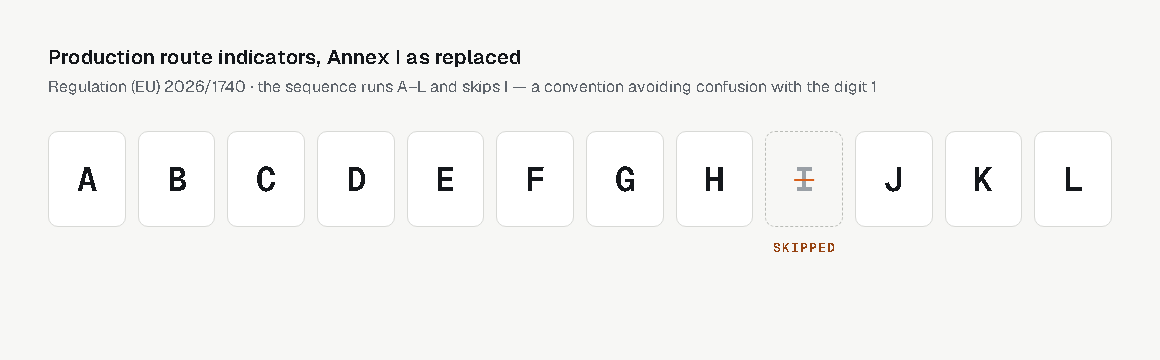
The sequence runs A to L and skips I — a routine typographic convention to avoid confusion with the digit 1, but one worth knowing if you are writing a parser that expects a contiguous alphabet.
The taxonomy itself is the actual metallurgy: blast furnace / basic oxygen furnace, direct reduced iron / electric arc furnace, scrap-based EAF, and separately for carbon, low alloy and high alloy steel; primary versus secondary aluminium. These are the routes with genuinely different emissions intensities, which is why the benchmark depends on them.
Recital 3 then closes a gap in the old text, and the resolution is stated in the annex introduction in two sentences:
“If no production route is indicated for a CN code, the CBAM benchmark (BM) is independent of the production route.”
“If a production route is indicated for a group of CN codes at HS code level (i.e. with 4 or 6 digits) and the CBAM BM as defined in Implementing Regulation (EU) 2025/2620 for one or more of the CN codes at 8-digit level in that group has no production route, the CBAM BM for the concerned CN code is independent of the production route.”
The second sentence is dense but the situation it addresses is simple. Some default values are given for a whole HS-level group with one route indicator attached. Inside that group there may be an eight-digit code for which 2620 defines no route at all. Under the December text you had an indicator pointing at a benchmark that did not exist for your code, and no rule saying what to do. There is now a rule.
If you had that question open, it is answered. If you did not have it open, you had probably not reached that part of the implementation yet.
The same discipline applies to missing-country data. Annex IV to 2025/2621 should not be treated as a generic “country missing” fallback for final goods. It covers precursors whose country of production cannot be identified; a software rule such as country missing → Annex IV is therefore too broad. For a listed country with a blank field, the fallback is the “Other countries and territories” table in Annex I.
8. The corrections that change specific numbers
Grouped by defect class, because they are not all the same kind of error.
Values that were simply wrong (recital 7). Transcription errors in Annex I for Taiwan, CN codes 7218 to 7223 — the stainless steel block, running from ingots and semi-finished products through flat-rolled, bars and wire — and for “Other countries and territories”, CN 7226 20 00.
A row with three separate errors (recital 8). For Angola, CN 2601 12 00 (agglomerated iron ores), the indirect emissions default was shown as not applicable. It should not have been: indirect emissions for that code are within scope under Article 7(1) of Regulation (EU) 2023/956. And the direct and total defaults printed for Angola turned out to be the numerical values from the “Other countries and territories” table. Three defects, one row.
Values omitted entirely (recital 9). This is the group with a monetary consequence, and the Commission spells it out. Annex I has a fallback: where a country is listed but no value is given, you take the value from “Other countries and territories”. Recital 9 states that those fallback values were “higher than or equal to the missing default values.”
So declarants following the annex correctly have been applying a higher figure than the one that should have applied, across eight country-and-code combinations in seven countries:
- Albania — CN 7202 41, ferro-chromium
- Gabon — CN 2804 10 00, hydrogen
- Guatemala — CN 7202 60 00, ferro-nickel
- Liberia — CN 2804 10 00, hydrogen
- New Caledonia — CN 7202 60 00, ferro-nickel
- Zambia — CN 7202 11, ferro-manganese
- Zimbabwe — CN 7202 11 and CN 7202 41
Those values have now been added. Because the correcting regulation applies from 1 January 2026, the country-specific values in the replacement annex govern those combinations for the 2026 period, replacing the fallback treatment that would otherwise have resulted from the blank fields in the earlier table.
One implementation distinction matters here: country of origin, country of export, and country of production are not interchangeable fields. Article 7’s default-value methodology for non-electricity goods is framed by exporting country, while the CBAM declaration separately records country of origin, and the precursor rules can require the country in which a precursor was produced. A CBAM data model should preserve those fields separately rather than collapsing them into a single country attribute.
Wrong codes (recital 11). CN codes for Tunisia were erroneous: 7615 10 10, 7615 10 30, 7615 10 80 and 7615 20 00 — aluminium table, kitchen and household articles, and sanitary ware.
Precursor mismatch (recital 13). Annex IV covers precursors whose country of production cannot be identified, and its governing principle is that you take the default of the third country with the highest emission intensity. For CN 7616 99 10 and 7616 99 90 the values did not correspond to that country. They now do.
Nomenclature (recital 12). Country names in Annex I did not match those in Annexes II and III, which follow Commission Implementing Regulation (EU) 2020/1470 on the nomenclature of countries and territories for European statistics on international trade in goods (OJ L 334, 13.10.2020, p. 2). Annex I has been aligned.
That last one looks like housekeeping. It can matter in software if tables are joined on country name rather than on a stable country identifier. A silent join failure produces a missing row, and a missing row in Annex I sends you to the “Other countries and territories” fallback — which, per recital 9, is the higher value. The failure mode of a name mismatch is overpayment, and it is invisible.
9. One small thing, since we are being precise
The indicator legend in the replacement Annex I renders entry (A) as “grey clinker / cementw”. The same legend reproduced in the replacement Annex IV reads “grey clinker / cement”, correctly.
A stray character in a correcting regulation. It changes nothing operative and I mention it only because it is the honest illustration of the point recital 7 already concedes: these are very large tables assembled under time pressure, by people, and the answer is not to assume they are perfect but to build systems that check.
10. What this changed for us
“Check your process” is easy advice to give and less comfortable to take, so here is what this regulation did to ours, with the evidence rather than the claim.
We build from a dated, hashed snapshot, not a live lookup. Our default value set is recorded as the tables as they stood on 4 February 2026. That sounds like bookkeeping until a correction applies retroactively to 1 January. Then the first question anyone will ask about a figure produced in March is which version of the annex produced this? A dated set answers that. A spreadsheet cannot.
We hit the white/grey clinker problem in ingestion, and we hit it because of the blank column. The comment sitting in our ingest code since we built it reads:
“Cement variant determines the Annex I route (2621: (A) grey, (B) white); the column-I cell is typically blank for cement, so the route comes from the variant.”
We could not read the production route for cement out of the route column, because for cement that column was usually empty. So we recovered white-versus-grey from the description text and synthesised the route indicator ourselves — (B) for white, (A) for everything else.
That was a workaround for an under-specified table. Recital 5 has now fixed the same defect at source, structurally, with TARIC codes. Our reading turns out to have been the right one; it should not have had to be a reading.
The mark-up basis was already right, and it is locked by a test. Our engine applies the mark-up on the total, direct plus indirect, and never on a direct figure alone; a test fails if anyone changes that. Recital 10 has now made the same rule explicit at regulation level. We match — but we match because a golden test enforces it, not because someone remembered.
The rounding conclusion was the same, reached from the opposite direction. Our ingestion takes each published value at full precision, verbatim, rather than re-rounding to three decimals, and the reason recorded in our own manifest is that three-decimal rounding moved the result by a cent on steel. Recital 10 gives rounding inconsistency as the reason for deleting the pre-multiplied columns altogether. We arrived at the same place from the implementation side; the Commission arrived at it from the drafting side.
And we do not take a published table on trust. Every row is reconciled on the way in: we recompute base total × mark-up and check the result against the published marked-up column, allowing for the rounding in the published figure. The ingest holds a known baseline, and any anomaly it has not seen before halts the run rather than flowing quietly into the system. A reference table you cannot re-derive is a reference table you should not be billing from.
That gate is the other reason recital 10 reads, to us, less like news than like confirmation: it describes precisely the class of defect the check exists to catch. I am not claiming foresight. We did not predict this regulation. We built the check because a table of that size, assembled against that deadline, is something you verify rather than assume.
A gate like that also carries an obligation. When it fires on the corrected annexes, the finding goes to the Commission service responsible for the file — not only into our own baseline. A reference table of this kind is shared infrastructure: the same rows price the same goods for every declarant in the Union. A check that protects only your own customers is half a check.
One caveat on reading such a check, because it cuts both ways. A blank cell is not an error. The introductory part of Annex I is explicit that where a country is listed but the field is empty or shows ”–”, you take the value from the “Other countries and territories” table. That is the annex working as designed, and anyone auditing these tables — us included — has to keep the difference between absent by design and absent by mistake firmly in view before saying a word in public.
And here is what we did about it. Our set was ingested in February and predated this regulation, so we brought in the corrected annexes; they have been in service since 19 August 2026.
The gate is one sentence: no declaration is produced until every figure the system generates reconciles to Annexes I and IV as replaced by Implementing Regulation (EU) 2026/1740, and to nothing else. Not “most rows updated”. Not “the big ones first”.
11. Where things stand today
- In force: Implementing Regulation (EU) 2025/2621, with Annexes I and IV as replaced by Implementing Regulation (EU) 2026/1740.
- Applicable from: 1 January 2026. There is no period of 2026 governed by the December version of the annexes.
- Mark-up rates: unchanged — 10 % (2026), 20 % (2027), 30 % (2028 onwards) for cement, iron and steel, aluminium and hydrogen; 1 % (2026 onwards) for fertilisers.
- Mark-up basis: the total emissions column. Direct and indirect defaults are informational.
- Where the default-value mark-up is applied: the CBAM Registry.
- Codes requiring TARIC rather than CN8: clinker (2523 10 00), hydraulic cement (2523 90 00), calcined kaolinic clay (2507 00 80).
- Adopted: Brussels, 20 July 2026, signed for the Commission by its President, Ursula von der Leyen, in accordance with the opinion of the CBAM Committee.
The first annual CBAM declaration, covering 2026 imports, is due by 30 September 2027, with the matching certificates surrendered.
Closing
There is a version of this article that treats a corrigendum as an embarrassment for the Commission. I do not read it that way, and I say that as someone who has spent a career on the receiving end of regulatory tables.
Pricing carbon at eight-digit granularity for every country that ships into the Union is a table with tens of thousands of cells, assembled against a fixed application date. Errors were not a risk; they were a certainty. What matters is that they were found, published in full with the reasoning attached, and applied from 1 January 2026 rather than only from August.
None of which makes life simpler for the people implementing it. The annex is a moving object: between 16 December 2025 and 20 July 2026 it changed shape, changed granularity, changed which of its columns is operative, and changed an unknown number of individual values. So “we downloaded the annex” is not a compliance position. The declaration you file in September 2027 covers your 2026 imports, and it will be assessed against the version in force — not the version you saved.
If you take one thing from this: go and find out what your system multiplies by 1.10, and whether it can tell white clinker from grey.
Ayfer Erdoğan is co-founder and CEO of Sustys.
Primary sources: Commission Implementing Regulation (EU) 2026/1740 of 20 July 2026 (OJ L, 2026/1740, 31.7.2026) · Commission Implementing Regulation (EU) 2025/2621 of 16 December 2025 (OJ L, 2025/2621, 31.12.2025) · Commission Implementing Regulation (EU) 2025/2620 of 16 December 2025 (OJ L, 2025/2620, 22.12.2025), point 5.2.1 · Commission Implementing Regulation (EU) 2023/1773 of 17 August 2023 (OJ L 228, 15.9.2023, p. 94), points 3.2.1 and 3.2.2 · Regulation (EU) 2023/956 of the European Parliament and of the Council of 10 May 2023 (OJ L 130, 16.5.2023, p. 52), Article 7 and Annex IV point 4.1 · Regulation (EU) 2025/2083 of the European Parliament and of the Council of 8 October 2025 (OJ L, 2025/2083, 17.10.2025) · Commission Implementing Regulation (EU) 2020/1470 of 12 October 2020 (OJ L 334, 13.10.2020, p. 2).
Editorial note on legal hierarchy
This article distinguishes between the default-value framework in Implementing Regulation (EU) 2025/2621, whose Annexes I and IV are replaced by Implementing Regulation (EU) 2026/1740, and the free-allocation adjustment rules in Implementing Regulation (EU) 2025/2620. The CBAM Regulation itself, Regulation (EU) 2023/956 as amended by Regulation (EU) 2025/2083, remains the higher-level legal basis.
For implementation purposes, a default-value table should therefore not be treated as a standalone certificate-calculation formula. It is one regulatory input within the wider CBAM calculation chain, alongside the applicable free-allocation adjustment and, where applicable, the carbon-price adjustment.
Next: the mechanism this all feeds — CBAM default values and the markup — or estimate a line with the free CBAM calculator.